If your garden room programme slips because the base is late, everything above it slips too. That is why screw piles have become a serious foundation option for garden rooms, annexes and outdoor buildings. They remove the slowest, messiest parts of groundworks and replace them with a fast, precise system that can be installed and ready to build on the same day.
For builders, that means cleaner scheduling and fewer moving parts. For property owners, it means less disruption in the garden and no waiting around for concrete to cure. The appeal is obvious. But the real value is not just speed. It is getting the right foundation, at the right depth, in the right ground conditions, installed accurately enough that the structure above starts square and level.
What screw piles actually do
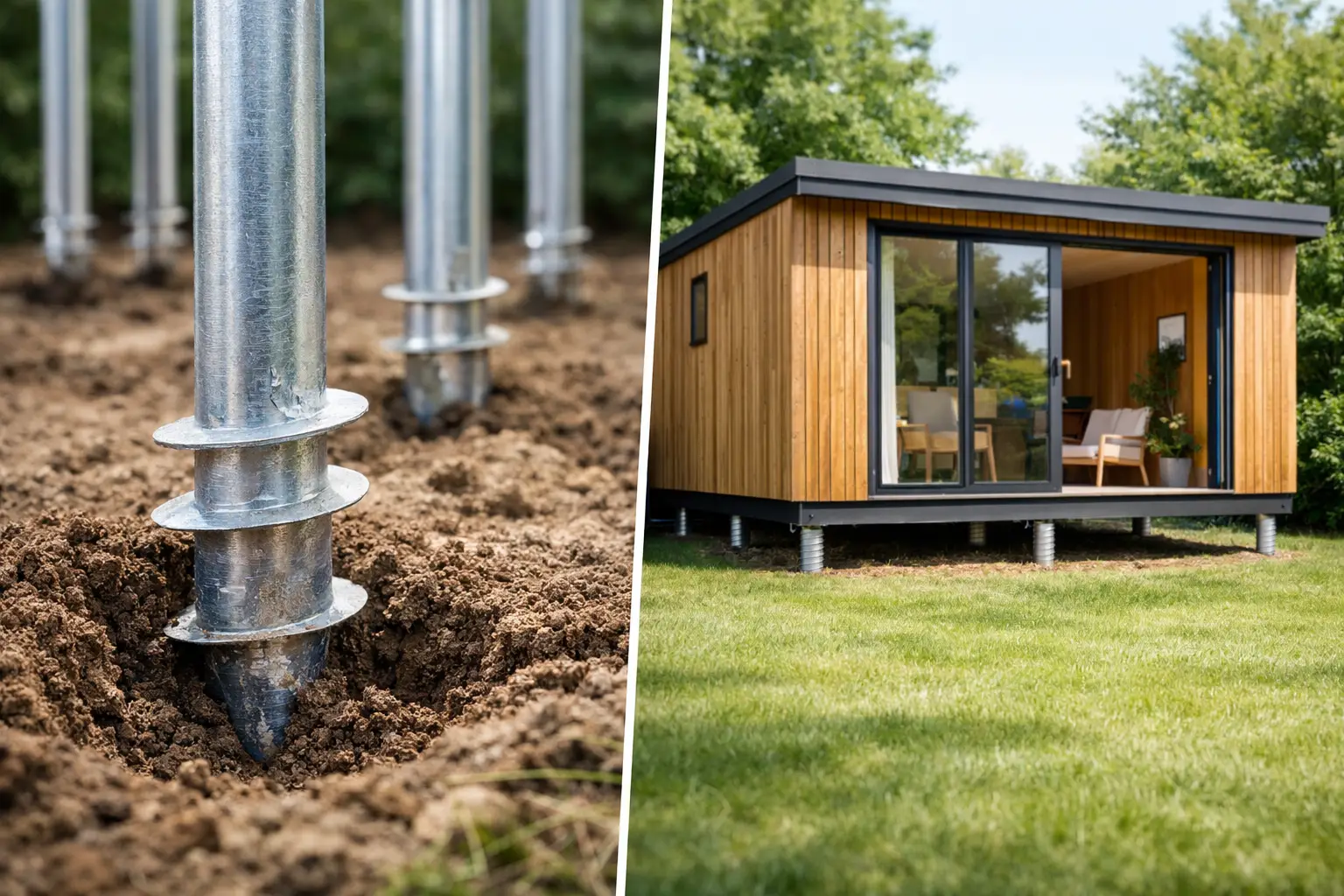
Screw piles are steel foundation elements that are mechanically driven into the ground to a specified depth and torque. In simple terms, they transfer the load of the structure into stable ground without the need for excavated pads or strip footings. Once installed, they can support a steel frame, timber ring beam or another designed connection system for the building above.
That sounds straightforward, and it is, when it is done properly. The key is that screw piles are not a generic one-size-fits-all product. Diameter, length, wall thickness, helix arrangement and head detail all matter. So does the layout. A lightweight garden office on firm ground needs a different solution from a larger annexe on softer or more variable soil.
Why screw piles suit garden rooms so well
Garden rooms need accuracy more than brute force. The structure above is usually manufactured or semi-manufactured to fixed dimensions, which means the foundation has to land in the right place and at the right height. There is not much room for error.
Concrete can achieve that, but it often does so slowly and with more site disruption than the project really needs. Excavation creates spoil. Wet trades introduce weather risk. Cure time slows the handover to the next stage. On tighter access sites, getting materials and equipment in and out can be awkward as well.
Screw piles cut through most of that. No concrete. No excavation. Very little mess. In many cases, installation is completed in hours rather than days. That makes them especially useful for garden room companies and tradespeople who want predictable handovers and fewer delays between groundwork and build day.
There is another practical benefit. Because the process is cleaner and more controlled, screw piles are often a better fit for finished gardens and occupied homes. If the client has invested in landscaping, paving or planting, reducing disturbance matters.
Screw piles vs concrete foundations
The comparison is not just about speed, although speed is a major factor. It is really about process.
Concrete foundations depend on excavation, forming, pouring and curing. They work well, but they bring wet trades, variable ground conditions in the excavation, and the possibility of weather-related delays. They can also mean more reinstatement afterwards, especially where spoil removal and access are difficult.
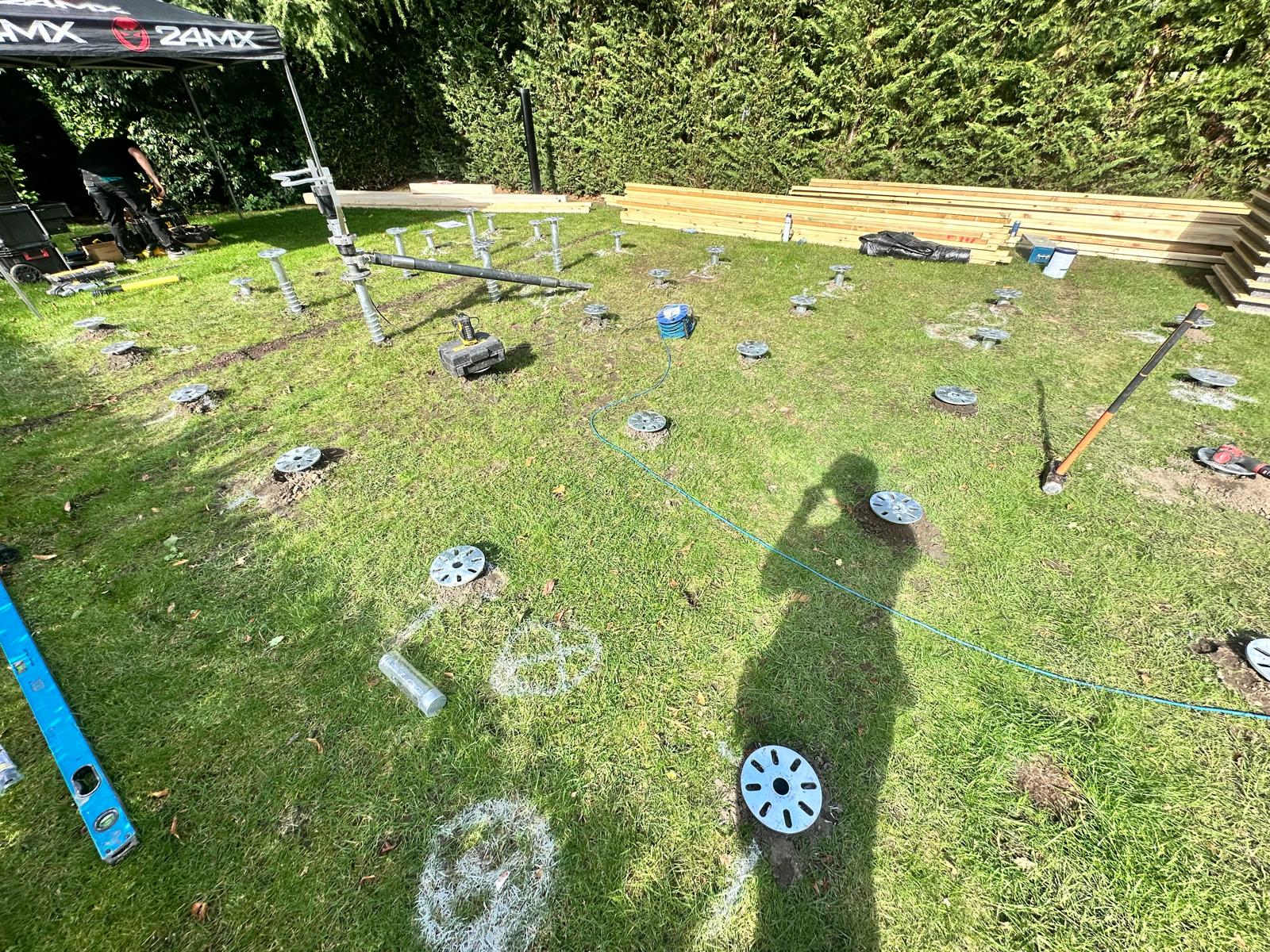
Screw piles avoid those stages. The piles are driven directly into the ground using specialist machinery, checked during installation, then cut or adjusted to the required level and fitted with the correct bracket or head arrangement. The foundation can then be used straight away.
That does not mean screw piles are automatically better on every project. If a site has unusual structural requirements, extreme loading, buried obstructions or constraints that affect installation equipment, the specification may need more thought. Some builds still suit conventional foundations. The point is that for many garden rooms and similar structures, screw piles offer a faster and cleaner route to the same end result - a stable, build-ready base.
How the right screw pile system is chosen
This is where experience matters. A proper specification is based on the structure, the loads, the site layout and the ground. Soil type affects embedment depth and pile performance. The weight and design of the building affect pile size, spacing and quantity. Access affects installation method.
A small insulated office with glazed doors is one thing. A larger annexe with heavier wall build-up and more demanding load paths is another. The same applies to sloping ground, made ground or sites with signs of variable bearing conditions. Choosing the right screw by guesswork is not good enough.
That is why contractor-grade foundation work starts with assessment, not assumption. The installer needs to understand what is being built and what the ground is likely to do. In some cases, load testing is part of that process. It gives additional confidence that the selected pile and installation depth are appropriate for the site.
The installation process in practice
On a well-planned job, screw pile installation is efficient from the start. The building footprint is marked out. Positions are set accurately. The piles are then driven into the ground using the appropriate machinery for the site and access conditions.
During installation, depth and resistance are monitored so the installer can confirm the pile is achieving the required performance in the ground. That matters. A foundation is not just about reaching a target depth. It is about achieving a stable result that reflects actual site conditions.
Once the piles are installed, heads or brackets are fitted to suit the frame design. Final levels are checked. The goal is simple - level, square, build-ready support. No waiting for material to cure. No returning days later to see if the next stage can begin.
For trade customers, that reliability makes planning easier. For homeowners, it shortens the period where the garden feels like a work site.
Where screw piles work best
Screw piles are especially effective for garden rooms, annexes, studios, lodges, modular outbuildings and similar structures where speed, access and accuracy are priorities. They are also useful where excavation would be awkward or disproportionately disruptive.
Sites with limited access often benefit because the equipment and process can be less intrusive than traditional groundwork. Sloping gardens can also be a good fit, depending on design, because the support system can be adapted without the same level of cut and fill or retaining work that a concrete solution might trigger.
That said, every site has its own constraints. Tree roots, buried services, very dense obstructions or unusual ground conditions can influence what is practical. Good contractors flag that early rather than forcing a system where it does not belong.
Why accuracy at foundation stage matters so much
A garden room only goes together cleanly if the base is right. If levels drift, if positions are out, or if the support layout is inconsistent, the problems do not stay in the ground. They show up in the frame, the floor, the cladding and the finish.
That is why specialist installation matters more than many people expect. The foundation is not just another preparatory step. It sets the geometry for the whole build. Done properly, it removes friction for everyone involved after it. Done badly, it creates expensive adjustments later.
For that reason, a specialist foundation contractor is often a better choice than a generalist approach, especially on garden room projects where tolerance and sequencing matter. Ground Down works in that space every day, which is the difference between offering screw piles as one option among many and understanding how to deliver them reliably for this exact type of build.
Supply only or supply and install?
Both can work. If you are a trade customer with the right experience, equipment and understanding of the structural requirements, supply-only may make sense. It gives you control over installation while still allowing you to source the correct pile system.
For many projects, though, full supply and installation is the safer route. It reduces the risk of specifying the wrong product, setting out incorrectly or missing what the ground is telling you during installation. It also gives you one accountable party for the foundation package.
That matters when schedules are tight and the build above depends on getting the basics exactly right.
The real question is not whether screw piles are modern
The real question is whether they are the right fit for your project. On many garden room jobs, they are. They are fast, clean and precise. They reduce disruption. They remove cure time. Most importantly, they can deliver a foundation that is ready when the rest of the job is ready.
If you are planning a garden room, annexe or outdoor structure, start with the ground and get the specification right. Everything above it becomes easier when the foundation is sorted properly on day one.