A screw pile that goes in quickly is only half the job. What matters is whether it will carry the load you expect, in the ground you actually have, without movement that causes problems later. That is where load testing for screw piles earns its place. It gives you site-specific proof, not guesswork.
For garden rooms, annexes and other lightweight structures, that proof can save time and avoid expensive corrections. A pile layout might look right on paper, but ground conditions rarely read the drawings. Made ground, soft pockets, fill from old landscaping, buried debris and local variation across a single plot can all change performance. A proper test tells you what the pile can do in that spot, not what it should do in ideal conditions.
What load testing for screw piles actually proves
At its simplest, a load test checks how a screw pile behaves under force. The aim is not just to see whether it holds. The aim is to measure movement against applied load and confirm that the pile performs within acceptable limits.
That distinction matters. A pile can appear firm during installation and still settle more than expected once the structure is in place. Equally, a site can feel poor underfoot but still provide enough resistance at depth for a correctly specified screw to work well. Load testing cuts through assumptions.
For most garden room and small structure projects, the test is used to verify compressive capacity. In plain terms, that means checking how the pile handles downward load. Depending on the scheme, uplift and lateral performance may matter too, especially on exposed sites, sloping ground or structures with meaningful wind load. What gets tested depends on the project, the design loads and the level of confidence already available from the site information.
When load testing is worth doing
Not every domestic project needs a formal test. If the site history is clear, the ground conditions are consistent, and the installer has strong local experience with similar loads, it may be possible to proceed with confidence using the right screw specification and installation method.
But there are situations where testing is the sensible call. One is when the ground is uncertain. Another is when the build value is high enough that foundation risk becomes expensive. Trade customers often use testing when quoting larger jobs, unusual sites or repeatable schemes where one good set of results can support decisions across multiple plots.
It is also useful where there is a question to answer before installation starts in full. Can a shorter pile work, or is a longer shaft needed? Is the selected diameter right? Do the founding depths need to change across the site? A test can help resolve those points early, before piles are ordered or installed in volume.
For garden room builders, that can mean fewer programme surprises. For property owners, it can mean confidence that the base has been proven properly rather than installed on best guess.
How a screw pile load test is carried out
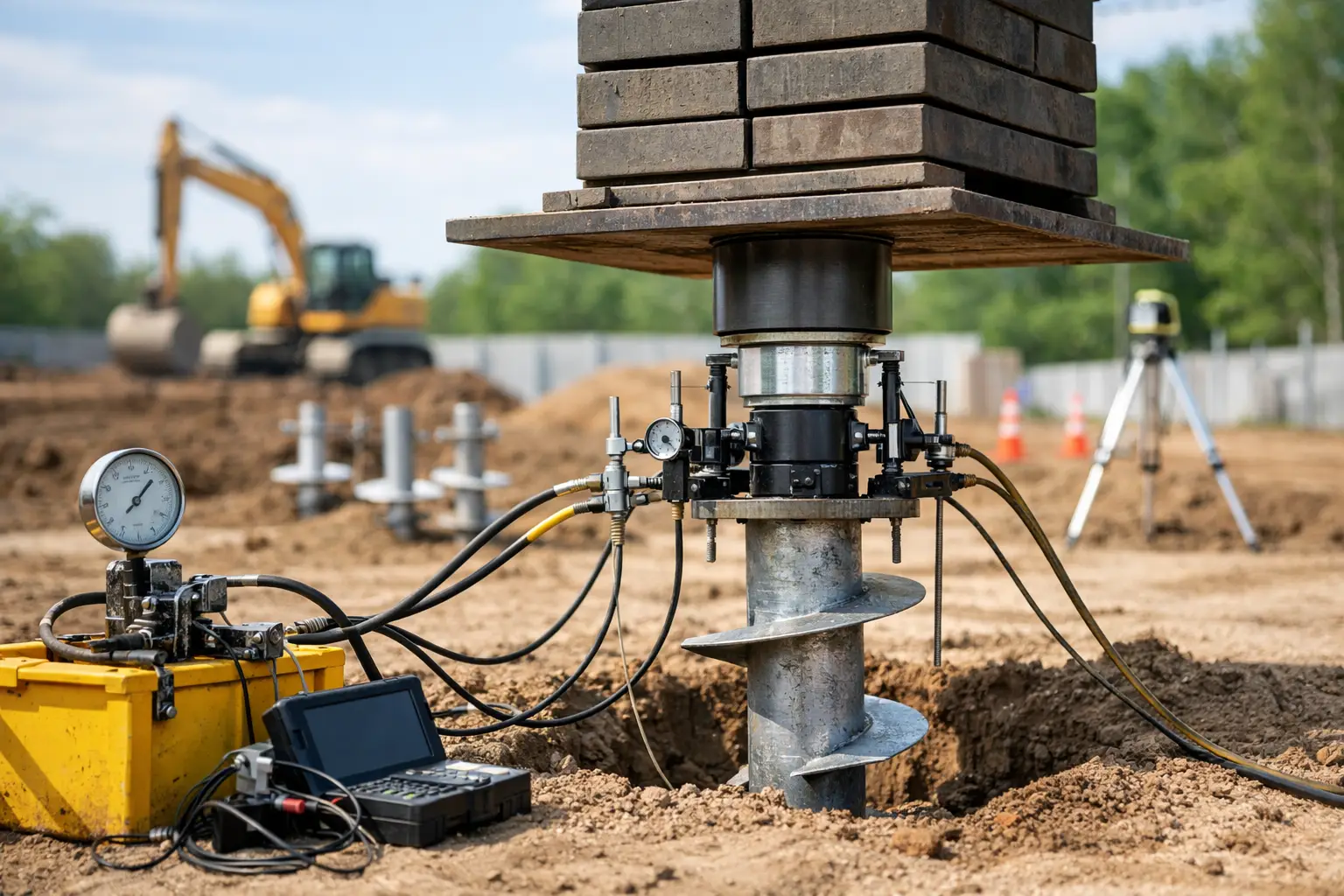
The setup is straightforward, but it needs to be done properly. A test pile is installed in the proposed location or in an area that represents the same ground conditions. A reaction system is then arranged so load can be applied in a controlled way. The pile is loaded incrementally, and movement is measured at each stage.
The key part is accurate measurement. You are not looking for rough feel or installer judgement. You are recording deflection under known load and checking how the pile responds over the full test sequence. That allows the results to be assessed against the required working load and any agreed acceptance criteria.
In practical terms, the test usually answers three things. First, whether the pile can achieve the required load. Second, how much movement occurs at that load. Third, whether the behaviour is consistent and predictable rather than showing signs of poor engagement or progressive failure.
A good test is not just about chasing the biggest number possible. Overloading a pile to make a point is not useful if the structure only requires a defined working load with limited settlement. The test should reflect the real design question.
Why installation torque is helpful, but not the whole story
People often ask whether installation torque is enough. It is certainly useful. Torque gives a real-time indication of the resistance the pile is meeting as it advances, and experienced installers use that information constantly. It helps with on-site decisions, consistency checks and quality control.
But torque is still an indirect measure. It is not the same as a direct load test. The relationship between torque and capacity depends on the pile type, shaft geometry, helix arrangement and the soil profile. On a straightforward site with proven history, torque data may be enough to support installation decisions. On a variable or higher-risk site, a direct test gives a stronger answer.
This is where specialist experience matters. You do not choose between torque and load testing in isolation. You use both pieces of information in the right context.
What the results actually mean
A passed load test does not mean every pile on the site can be treated casually. It means the tested arrangement has demonstrated performance under the conditions present at that location, using that specification and installation approach.
If the ground is uniform and the rest of the installation shows comparable behaviour, that result can be highly useful. If the site varies sharply, one successful test may not tell the whole story. More testing, different pile lengths or closer monitoring during installation may be needed.
It is also worth understanding the difference between ultimate capacity and working capacity. Ultimate capacity is the point at which failure or unacceptable behaviour occurs. Working capacity is the load the pile is intended to carry in service, with an appropriate margin for safety and control of movement. For a garden room foundation, service performance matters. You are not just trying to stop collapse. You are trying to create a stable, level base that stays right for the build above.
That is why settlement readings matter as much as raw capacity. A pile that technically carries the load but moves too much is not a good result.
Load testing for screw piles on garden room projects
Garden rooms are lighter than houses, but that does not make foundations an afterthought. These structures still need a square, level and dependable base. If one area settles, the problem shows up quickly in door alignment, glazing, cladding lines and internal finishes.
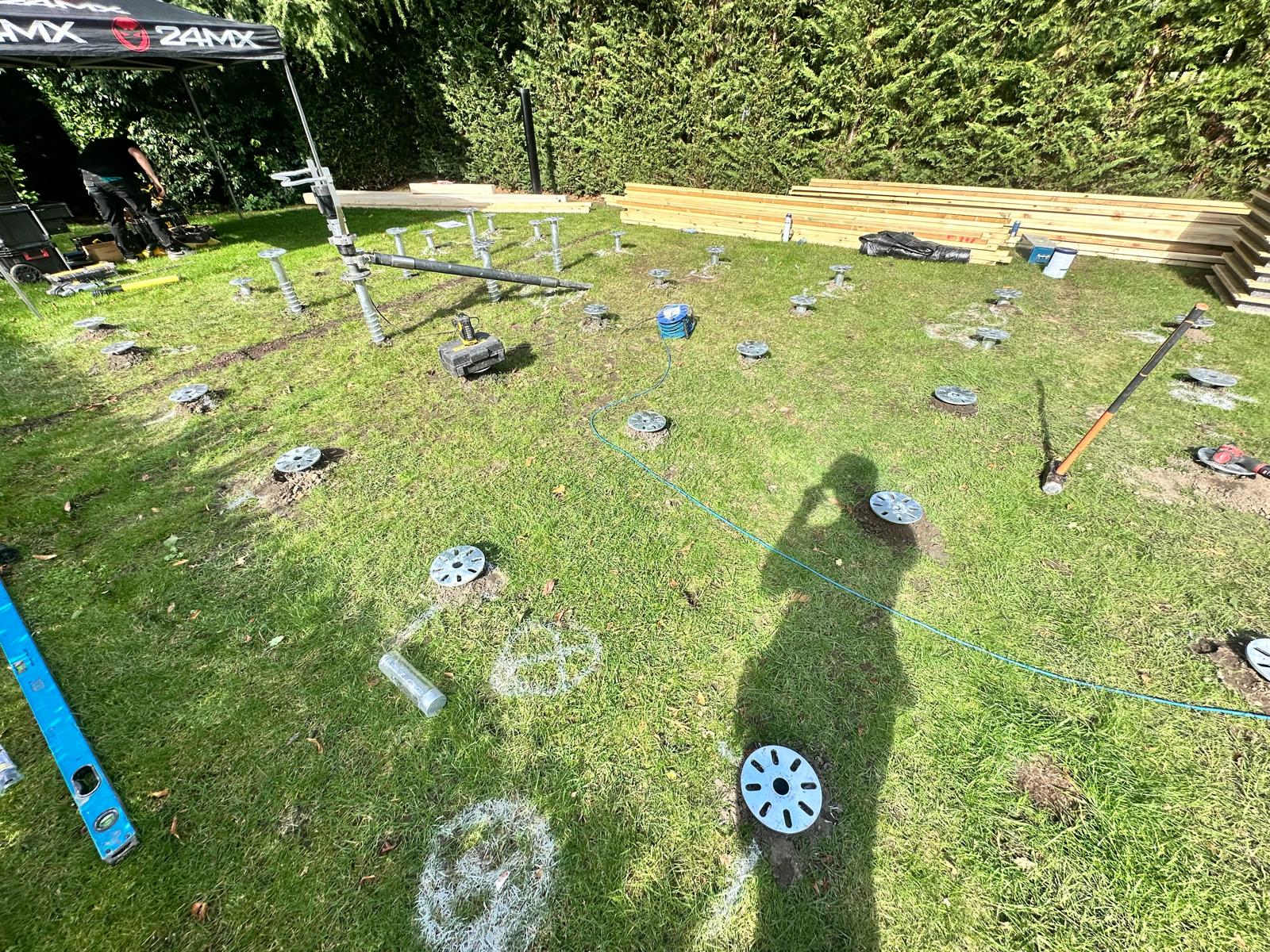
Screw piles suit this type of project because they can be installed quickly, with no excavation and no concrete cure time. The build can move on the same day. But that speed only works if the specification is right. Load testing for screw piles helps confirm that the chosen system matches the ground and the intended structure.
For builders working to tight installation windows, that confidence has a practical value. It reduces the chance of redesign on site. It supports better planning. It helps avoid the stop-start delays that happen when the foundation question is not properly settled before the frame turns up.
Common mistakes around testing
One mistake is assuming all plots in a development behave the same. They often do not. Another is treating testing as something only required on large commercial work. Domestic and light commercial projects can still suffer from poor ground assumptions, particularly on previously altered sites.
A third mistake is asking for a test too late. If the build schedule depends on a quick foundation install, the testing conversation should happen before materials and crews are committed. Used early, a test supports the job. Left until the last minute, it can feel like a delay rather than a safeguard.
There is also the opposite problem - testing when a simpler approach would do. If the site is straightforward and the pile design is already well proven for the load case, a full test may add cost without changing the decision. The right answer depends on risk, ground uncertainty and project value.
Choosing a contractor who understands the results
The test itself matters, but so does the judgement around it. The useful question is not just, can someone perform a test? It is, can they relate that result to the actual build, the screw specification and the ground conditions on the day?
That is where a specialist contractor adds value. If the same team understands pile selection, installation behaviour and test interpretation, you get a cleaner process. You are less likely to end up with technical data that looks impressive but does not help you make the next decision.
Ground Down provides load testing as part of that wider technical picture. For trade customers and property owners alike, the aim is straightforward - specify the right screw, install it properly and prove performance where the site calls for it.
A foundation should not be the uncertain part of the job. If the ground needs proving, prove it early and build on something you can trust.