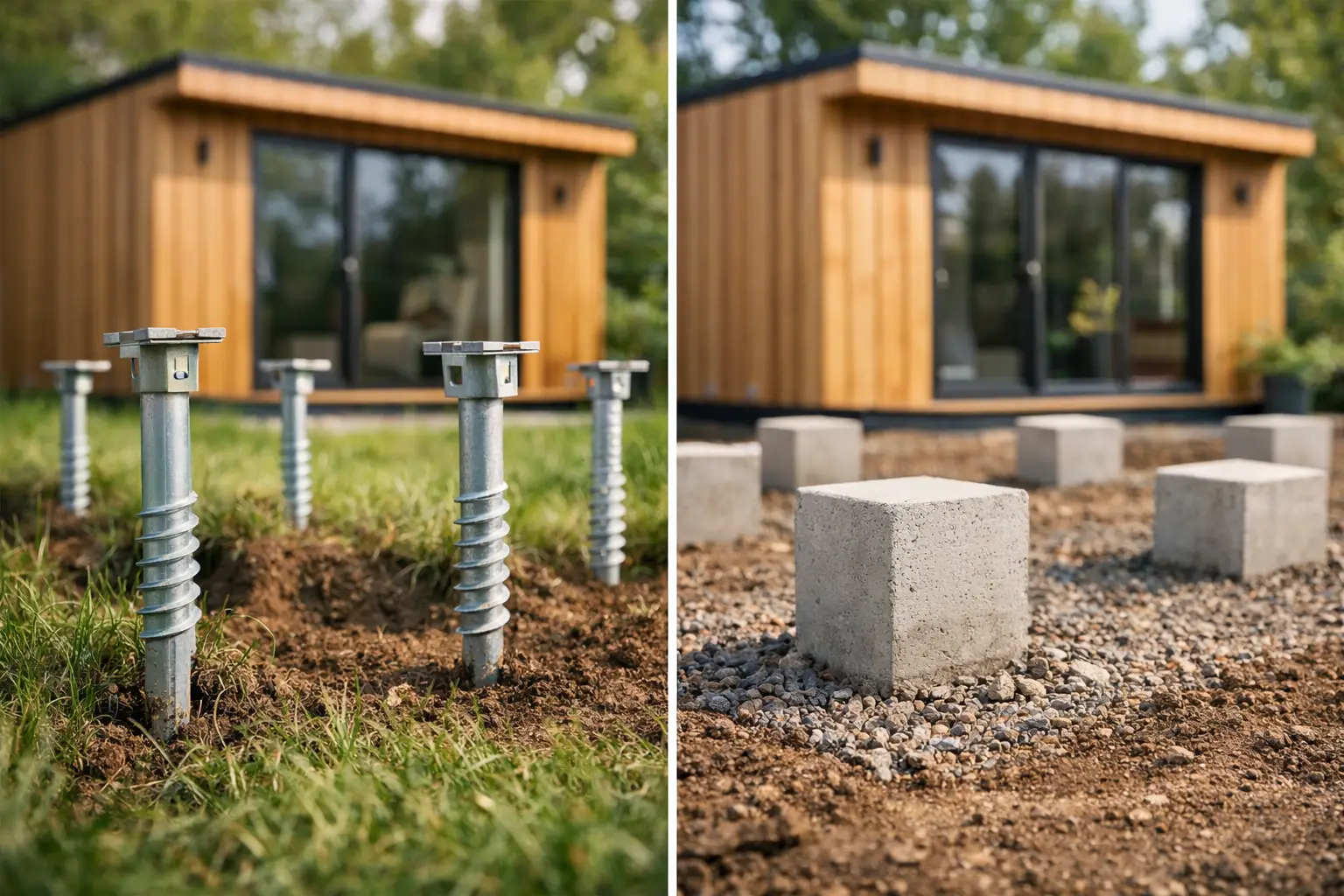
If you are weighing up ground screws vs concrete for a garden room, the biggest difference is not just the material. It is what happens to your project timeline, your site and the accuracy of the base you end up building on. One option is fast, clean and ready the same day. The other is familiar, but slower, messier and more dependent on weather, excavation and curing.
For garden rooms, annexes and similar outdoor buildings, that difference matters. The foundation is the first fixed point on site. Get it wrong, or get it late, and everything above it becomes harder.
Ground screws vs concrete: what actually changes on site?
Concrete has been the default for years. Dig out the area, remove spoil, bring materials in, pour the base or footings, then wait for it to cure before loading it. That process can work well, but it is labour-heavy and disruptive. Access can also become an issue if machinery, barrows or wet concrete need to pass through a finished garden.
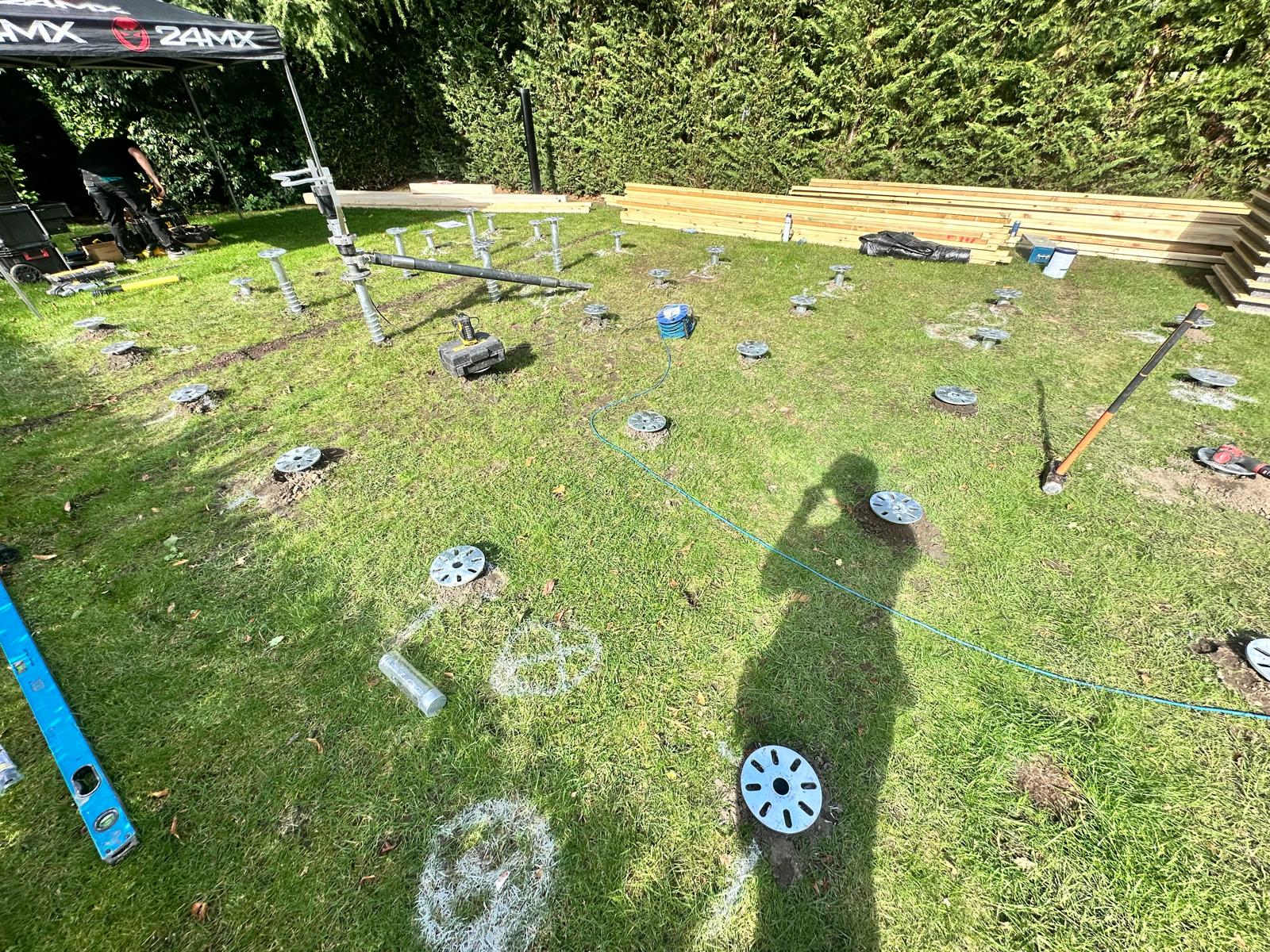
Ground screws change the sequence completely. Steel screw piles are mechanically driven into the ground to a specified depth and torque, then cut or adjusted to level and connected to the frame above. There is no excavation in the usual sense, no shuttering, no curing time and very little mess. In most cases, the foundation is ready to build on as soon as installation is complete.
That is why the comparison is not simply ground screws or concrete. It is speed or delay, clean install or dig-out, immediate build-readiness or waiting around for the next stage.
Speed matters more than most people think
For professional garden room builders, time on site affects everything. Labour scheduling, client handover dates and follow-on trades all depend on the base being ready when promised. Concrete introduces variables. Weather can interrupt excavation or pouring. Drying time can delay the build. If levels are not right, corrections take more time and money.
Ground screws are far more predictable. A site survey, a screw specification and a planned installation date give you a clear route to a build-ready foundation in hours rather than days. That reliability is a major reason many garden room companies now prefer screw pile systems for modular builds and timber-framed structures.
For homeowners, the benefit is just as clear. Less time spent turning a garden into a building site. Less waiting. Less uncertainty.
Accuracy is not a nice extra
A garden room does not forgive a poor foundation. If the base is out of level or out of square, the structure above has to compensate. That can lead to awkward packers, frame stress, poor door alignment and wasted installation time.
Concrete can be accurate when it is done properly, but it relies heavily on preparation, shuttering, level control and finishing. Small errors at ground level can become larger issues once the building starts.
Ground screws are installed to a set layout and adjusted to precise heights. For garden rooms, that matters. You want exact points, consistent levels and a foundation that matches the structure being installed, not a rough approximation that someone has to work around later.
This is where specialist installation matters. Screw size, spacing and depth should be based on the load above and the ground conditions below. It is not guesswork. Done properly, the result is a level, square foundation that is ready for the next trade straight away.
Site disruption: the difference clients notice first
Most clients do not get excited about foundations. They do notice churned-up lawns, piles of spoil and concrete splashes on a driveway.
Concrete is invasive by nature. You need to dig. You need to move material out and material in. Even on a straightforward site, there is more handling, more foot traffic and more mess. On tighter plots, side access and existing landscaping make this harder.
Ground screws are much cleaner. Minimal digging. Minimal spoil. No wet concrete. No curing area fenced off while the rest of the project waits. For occupied homes, that often becomes the deciding factor.
If the build is at the end of a garden, or access is narrow, a screw pile system can avoid a lot of unnecessary disruption. That is good for the client and good for the installer.
When concrete still makes sense
This is not a case of concrete being wrong every time. It still has a place.
If you are building a structure that genuinely requires a full slab, or the design depends on a continuous concrete base for reasons beyond foundation support, then concrete may be the right option. Some builds need that approach. Some engineers specify it. Some sites have conditions that favour a more traditional solution.
There is also the issue of familiarity. Many trades have used concrete for years and understand exactly how to work with it. That confidence can influence specification, especially on projects that sit outside the normal garden room model.
But familiarity is not the same as suitability. For many garden rooms, studios and annexes, a full concrete base is more than the project needs. It adds wet trade, extra labour and extra delay without improving the outcome.
Ground conditions matter in both systems
No foundation choice should be made in isolation from the ground itself. Soil type, drainage, slope and access all affect what is viable.
Concrete is not immune to poor ground. Weak soils may mean deeper excavation, more concrete or reinforced solutions. Sloping sites can become more complex and expensive very quickly.
Ground screws also depend on proper assessment. The screw diameter, shaft length and bracket detail need to match the load case and the site conditions. In some ground, installation is straightforward. In others, you may need testing or revised specification.
That is why an expert-led approach matters. The best results come from assessing the site first, then matching the foundation system to the structure and ground conditions. Not the other way round.
Cost: look past the headline number
People often ask which is cheaper. The honest answer is that it depends on what you include.
If you compare raw material cost alone, concrete can appear competitive. But projects do not run on raw materials alone. You need to factor in excavation, spoil removal, labour, plant, formwork, curing delays and the knock-on effect on the rest of the programme.
Ground screws can reduce or remove much of that. Faster installation means less labour on the foundation stage. No curing means the main build can start immediately. Less mess can mean less making-good afterwards. On a live residential site, those savings are real.
For trade customers, the cost benefit often shows up in programme control as much as the invoice itself. If your team can arrive to a base that is already installed, level and ready, you keep momentum. That has value.
Ground screws vs concrete for garden rooms on awkward sites
Awkward sites are where the gap often widens.
A sloping garden can make concrete slow and expensive. A plot with limited access can turn a simple pour into a logistical problem. Existing patios, planting and finished landscaping all raise the cost of disturbance.
Ground screws are often a better fit for these jobs because they need less site intervention. They can work well where excavation is impractical or where clients want the surrounding area left largely intact. They also suit raised structures, which are common on uneven ground.
That does not mean every awkward site is simple. It means the foundation method should reduce complexity where possible, not add to it.
The right question is not which is traditional
The right question is which foundation gets this specific structure built properly, on this specific site, with the least friction.
For many garden room projects, the answer is clear. Ground screws offer speed, precision and a cleaner install. They remove curing time. They avoid major excavation. They give builders a reliable starting point and property owners a less disruptive experience.
Concrete still has its place, especially where the design or engineering calls for it. But on a large number of modern garden room builds, it is simply the slower route.
That is why more builders and clients are moving away from defaulting to concrete and towards specialist screw pile foundations. Companies such as Ground Down are part of that shift because they focus on one thing and do it properly - specifying the right screws, installing them accurately and leaving a build-ready foundation on site the same day.
If you are planning a garden room, annex or outdoor structure, start with the base. The cleanest project usually begins with the least disruptive foundation.