If your garden room build is waiting on concrete, the programme is already slipping. Garden room foundation screws remove that bottleneck. They go in quickly, create a precise base, and leave you with a foundation that is ready to build on the same day.
That speed matters, but it is not the only reason builders and property owners are switching. A garden room foundation has one job - hold the structure level, stable and properly supported over time. If the base is out, everything above it becomes harder. Wall panels fight the frame. Door sets run out. Finishes start compensating for a problem that should never have existed.
Ground screws solve that in a very direct way. They replace excavation, poured concrete and curing time with a controlled installation process that is cleaner, faster and easier to programme.
What are garden room foundation screws?
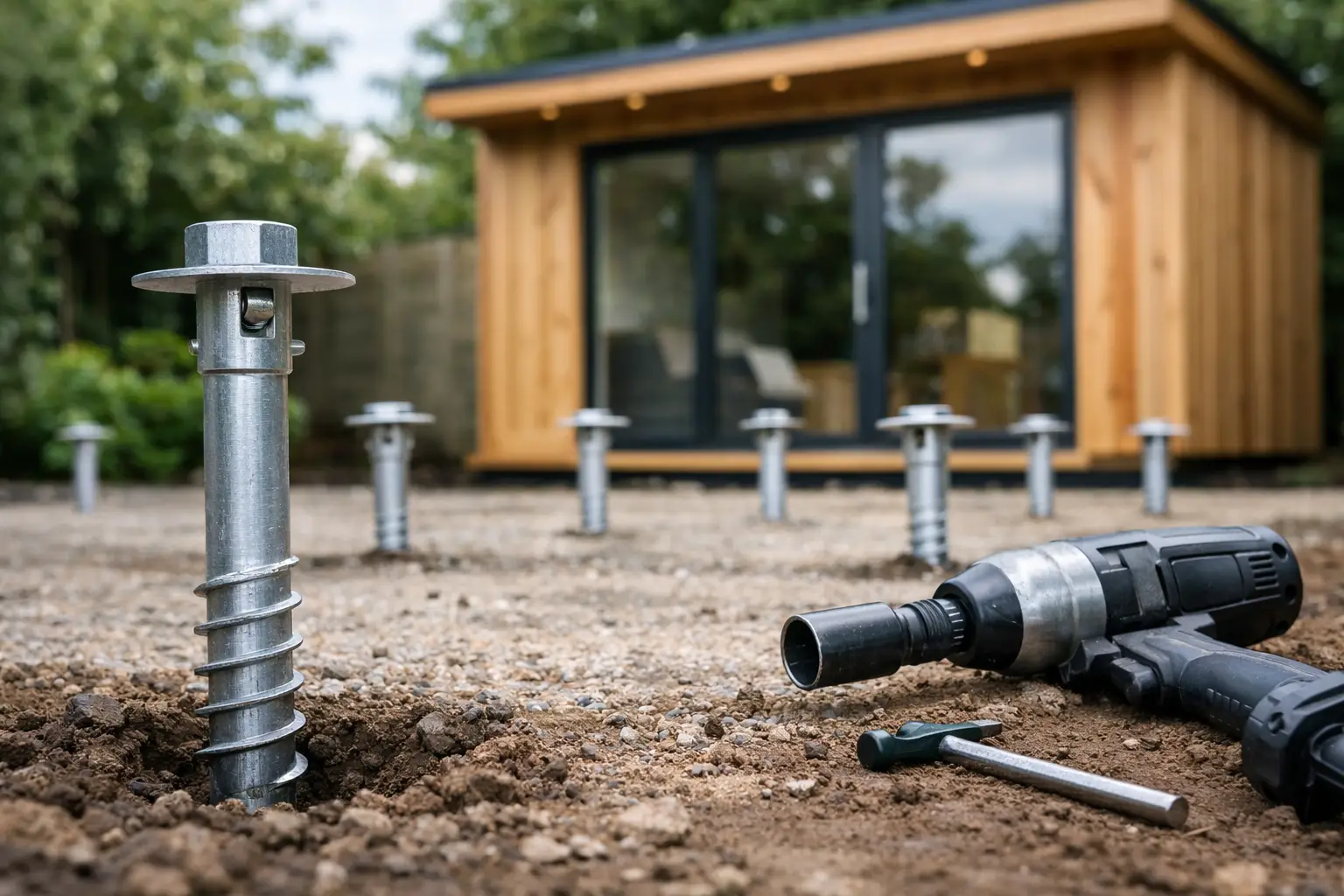
Garden room foundation screws are steel screw piles designed to form a structural foundation without digging out and pouring a traditional slab or pad. Each screw is driven into the ground to a specified depth and torque, then cut or adjusted to the required level so the subframe above can sit exactly where it should.
For garden rooms, that accuracy is a major advantage. These buildings are usually lightweight compared with a house extension, but they still need reliable support. Loads need to be transferred properly into the ground. Levels need to be right. Corners need to be square. A quick foundation is no use if it introduces movement or setting-out issues later.
This is why the screw itself is only part of the answer. The right diameter, shaft length, helix configuration and bracket detail all depend on the structure above and the ground below. Done properly, the result is a foundation system matched to the job rather than forced into a one-size-fits-all concrete approach.
Why builders choose garden room foundation screws over concrete
Concrete is familiar. That is why many people still default to it. But familiarity is not the same as efficiency.
With a concrete base, you are usually dealing with excavation, spoil removal, material deliveries, weather sensitivity and curing time. Even on a straightforward site, that introduces delay and site mess. On tighter plots or gardens with limited access, it becomes even less attractive.
Garden room foundation screws strip out most of that friction. There is little to no excavation. There is no wet trade waiting to go off. Installation is fast, and the base can often be handed over ready for the next stage immediately.
That matters to trade installers because time on site costs money. It matters to homeowners because fewer days of disruption is always better. It also matters to garden room companies trying to keep installation schedules tight and predictable.
The other big advantage is control. A screw pile foundation can be set out and adjusted with a high degree of precision. That gives the structure above a better starting point. If you build garden rooms regularly, you know how much easier the full install becomes when the base arrives level, square and on plan.
Where garden room foundation screws work best
They suit a wide range of garden room projects, including offices, gyms, studios, annexes and larger bespoke outdoor buildings. They are especially useful where access is restricted, where clients want to avoid heavy excavation, or where site conditions make a concrete pour awkward or inefficient.
They also come into their own on sloping ground. Cutting and filling to force a level concrete base can be slow and expensive. Screw piles allow the foundation to step or sit above varying ground levels far more efficiently, provided the specification reflects the loads and site conditions.
That said, no foundation method is universal. Ground conditions still matter. So does the design of the structure. Made ground, buried obstructions, unusual load cases or waterlogged areas may all affect the approach. The right answer starts with assessment, not assumptions.
How the specification is decided
The best results come from matching the screw specification to the project, not just picking a standard size because it worked somewhere else.
A proper specification takes account of the building size, intended use, structural loads, support layout and ground conditions. A small insulated office and a large annexe with heavier build-up are not the same job. They may look similar from the outside, but their foundation demands can be quite different.
Soil type is a major factor. Dense, stable ground behaves differently from softer or more variable strata. Screw length and diameter need to reflect that. In some cases, load testing is used to confirm capacity and remove guesswork. For trade customers, that kind of technical input matters because it reduces risk before the building arrives on site.
Bracket choice matters as well. The connection between the screw and the substructure needs to suit the frame design above, whether that is timber, steel or a specific proprietary system. Good foundation work is not just about getting metal into the ground. It is about handing over a base that integrates cleanly with the build.
What installation actually looks like
This is one of the reasons the system appeals to both professionals and homeowners. The process is straightforward.
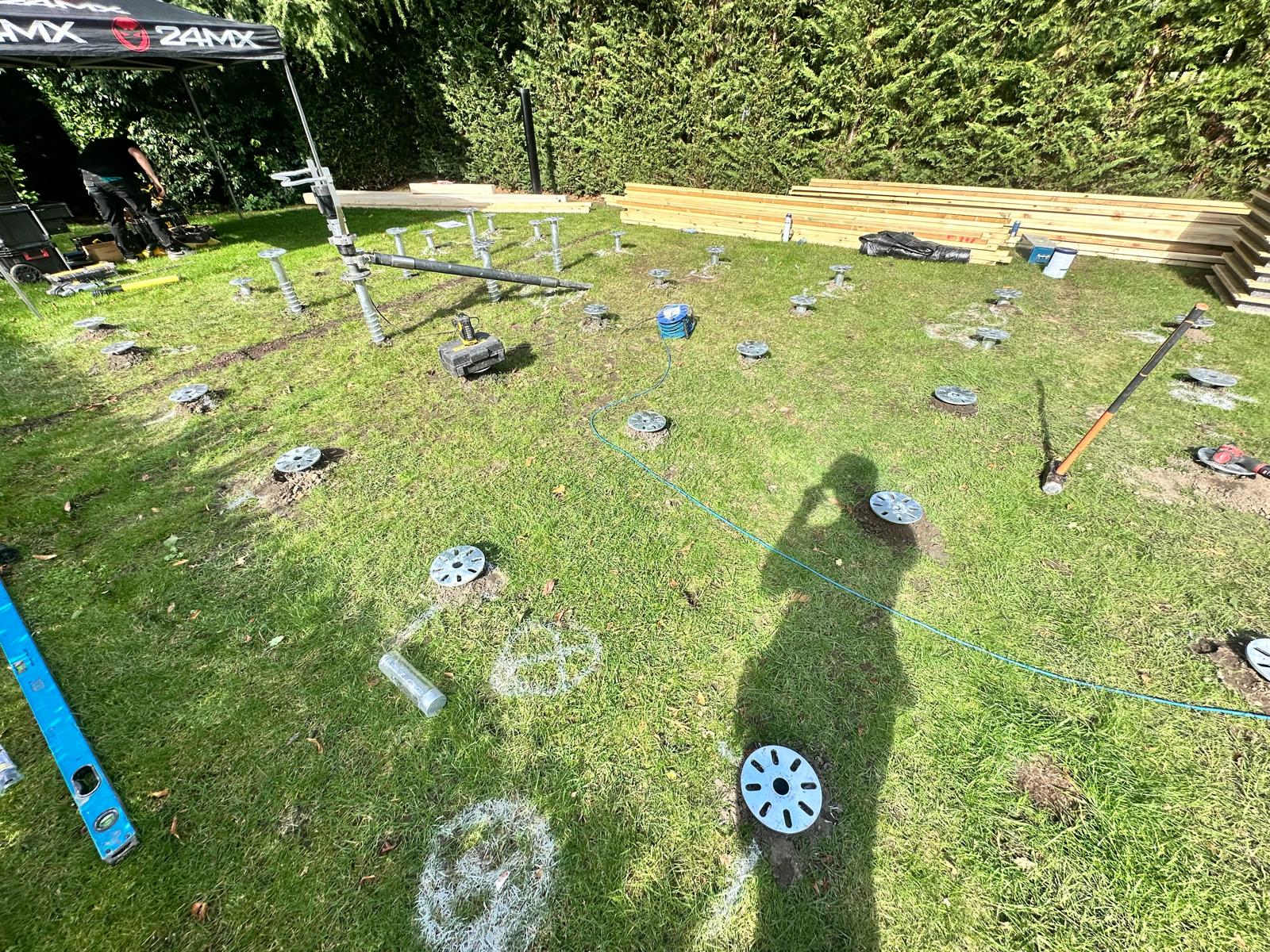
The area is set out accurately to the foundation plan. Screws are then installed using specialist machinery to the required position, depth and torque. Once installed, they are trimmed or adjusted to level and fitted with the appropriate heads or brackets for the structure above.
Because there is no concrete to pour and no cure time to wait for, the foundation can be ready for construction as soon as installation is complete. On many projects, that means the garden room build can move straight on without losing days to groundwork.
It is also a much cleaner process. There is far less spoil, less disturbance to the surrounding garden and no concrete wagons or wet materials to manage. On domestic properties, that cleaner installation is often one of the biggest practical benefits.
The trade-offs to be aware of
Fast does not mean careless, and cleaner does not mean cheaper in every case. There are trade-offs.
For very simple projects on easy-access sites, some clients will still compare screw piles against a basic concrete option on headline cost alone. If they ignore programme time, spoil removal, labour and the value of a same-day build-ready foundation, concrete can appear cheaper at first glance.
But that is not the full picture. Delays cost money. Return visits cost money. So does sorting a poor base once the superstructure install has started.
There are also projects where a screw solution needs proper technical review because the ground is inconsistent or the structure is heavier than a standard garden room. That is not a weakness of the system. It is simply the reality of doing foundations properly. The right contractor will tell you when a project is suitable, when testing is sensible and what specification is required.
Why precision matters more than speed
Speed gets attention. Precision is what protects the build.
A garden room installer needs clear datum points, reliable levels and support positions that actually align with the frame. If the foundation is even slightly off, the knock-on effect can run through the entire job. You lose time making allowances. You introduce stress into the structure. You risk visible finish issues that clients notice long after the installers have left.
That is why experienced screw pile installation is so valuable. The benefit is not just that the foundation goes in quickly. It is that it goes in accurately. For builders running a schedule, that means fewer surprises. For homeowners, it means the finished room performs as it should.
Specialist contractors who focus on this category understand those tolerances. They know garden room loads are not the same as fence posts, and not the same as a full dwelling either. The details matter. Screw spacing matters. Setting out matters. Connection detail matters.
Choosing the right foundation partner
If you are comparing options, ask practical questions. How is the screw size selected? What information is needed before installation? Is load testing available where required? Can the contractor supply and install, or support supply-only projects for competent teams? How accurately will the base be handed over?
You are not just buying metal. You are buying confidence that the structure above has the right start.
For builders and property owners in the South East, working with a specialist such as Ground Down means dealing with a contractor that understands garden room foundations specifically, not as a side line. That usually shows up in the details - quicker quoting, clearer specification advice, cleaner installation and a build-ready result without the usual concrete delay.
The best foundation is the one that makes the rest of the project easier. If your priority is a clean site, a tight programme and a base done properly, garden room foundation screws are hard to beat. Get that part right and everything above it has a better chance of going exactly to plan.