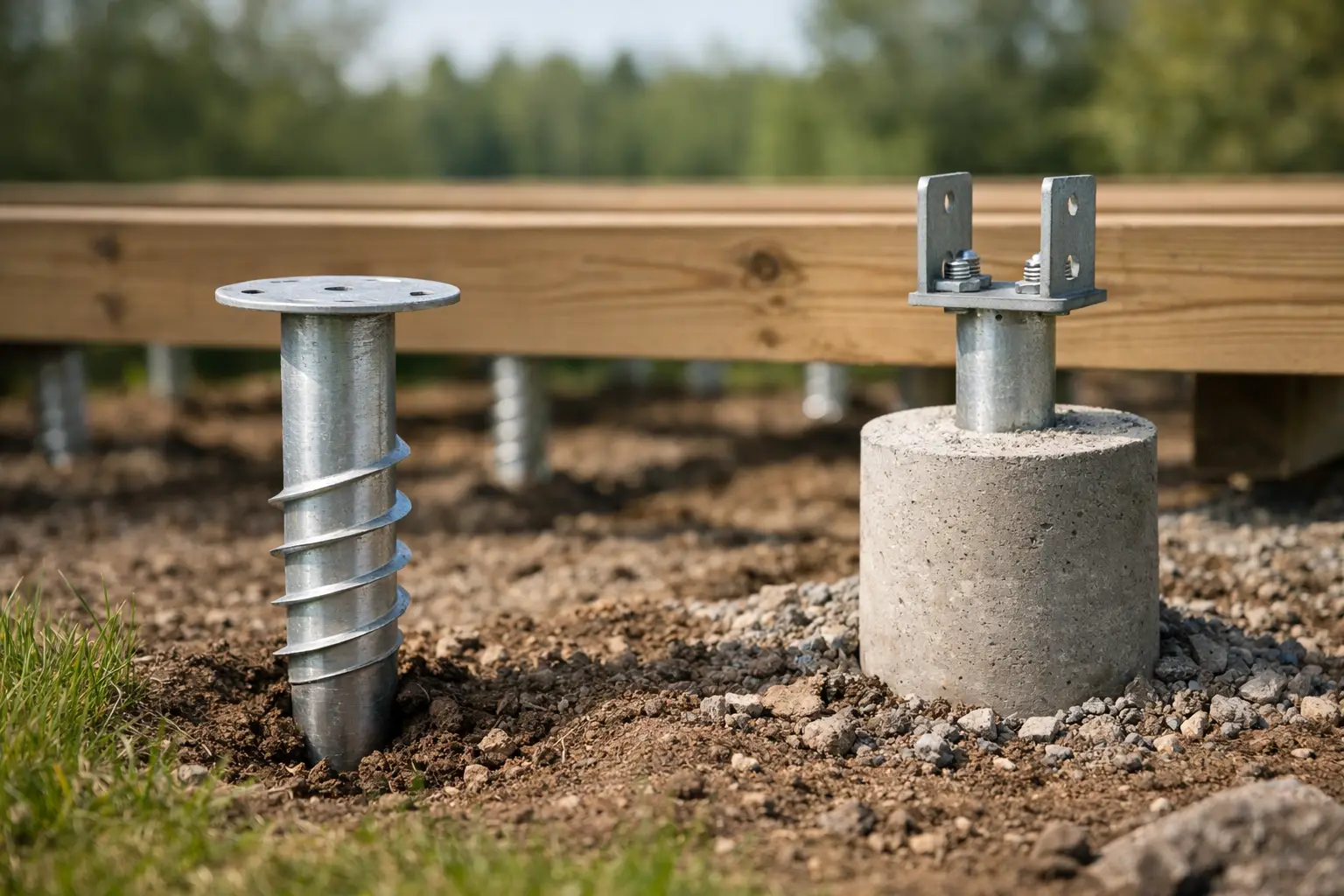
If your build programme is being held up by digging, spoil removal and waiting for concrete to cure, the question is fair: can ground screws replace concrete footings? For many garden rooms, annexes and similar outdoor structures, yes, they can. But not as a blanket rule. The right answer depends on the load, the ground conditions, access and how accurately the foundation is specified and installed.
Ground screws are not a shortcut. Done properly, they are a structural foundation system. They transfer load into the ground through steel screw piles installed to a defined depth and layout. That gives you a level, build-ready base without excavation, wet trades or a concrete lorry on site.
Can ground screws replace concrete footings for every project?
Not every project. Plenty of them, yes. Every one, no.
For garden rooms, modular buildings, annexes, verandas, studios and other lightweight to medium-weight structures, ground screws are often a very strong alternative to traditional concrete footings. They suit projects where speed matters, where access is awkward, or where clients want a cleaner install with minimal disruption.
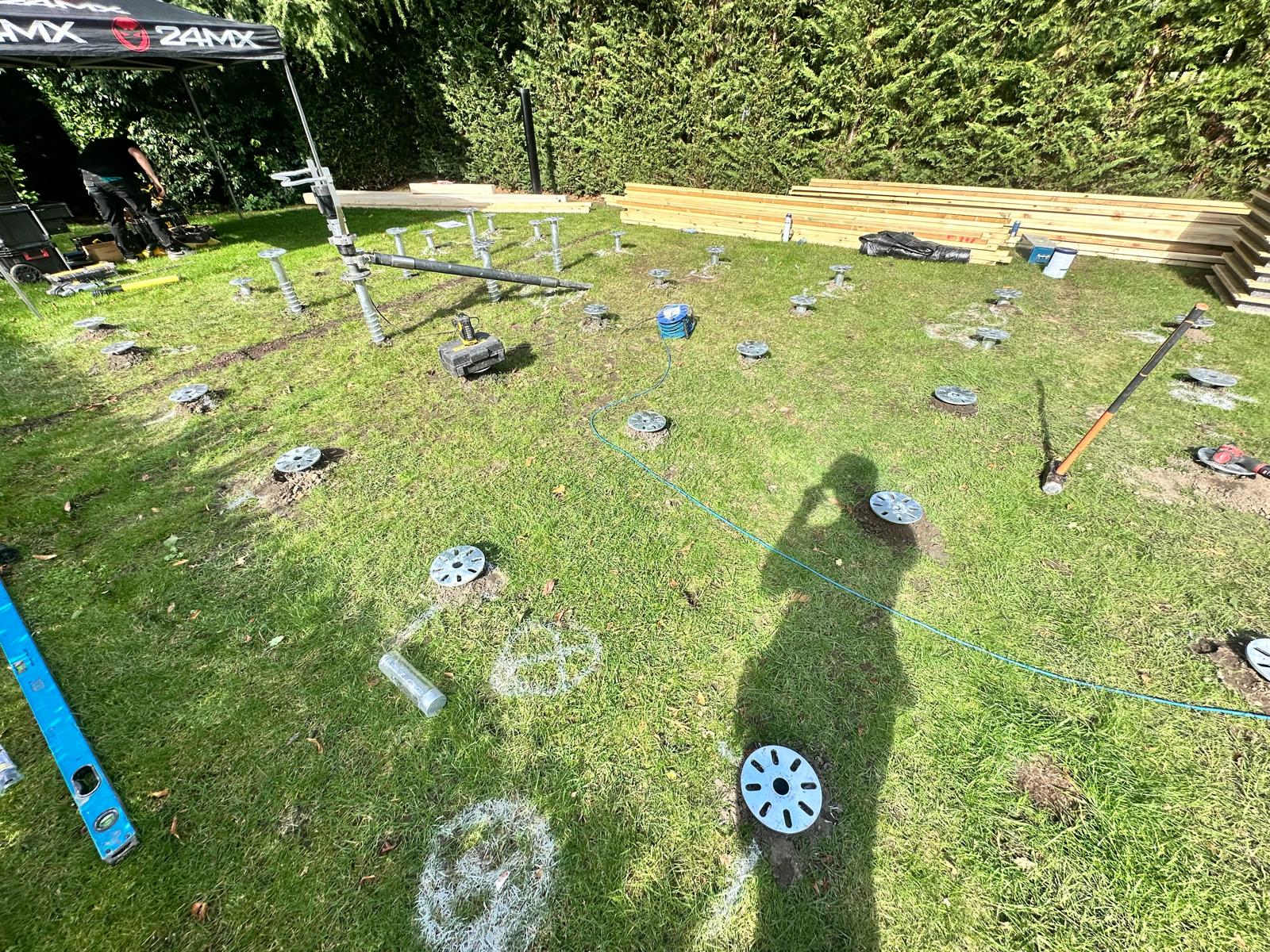
Where they are especially effective is on sites where you want accurate foundation points installed in a single visit. There is no trenching. No shuttering. No curing time. The screws go in, brackets are set to level, and the building team can move straight onto the next stage.
The reason concrete still appears on many projects is not that it is always better. It is often just the default. Builders know it, engineers know it, and planning assumptions sometimes lean that way. But default is not the same as best.
Where ground screws work best
Ground screws perform well on the sort of projects Ground Down deals with every day - garden rooms and outdoor buildings that need a stable, precise base without the mess of traditional groundwork.
They are particularly well suited when the structure is raised above ground level, when the site slopes, or when the footprint needs to be kept neat and controlled. They also make sense where access is too tight for larger excavation equipment or ready-mix delivery. In a back garden in South East England, that matters more often than people think.
For installers and garden room companies, the advantage is practical. You get known foundation positions. You get a square and level datum. You avoid losing days to weather, concrete delays and follow-on trades waiting around. For property owners, the appeal is just as clear: less damage to the garden, less noise, less muck, faster progress.
Why builders are moving away from concrete footings
Concrete has been the standard for years, but it comes with obvious friction. First you mark out, then excavate, then manage waste, then pour, then wait. If levels are out, or holes drift, the building above has to absorb the error. That is where costs start creeping in.
Ground screws cut out most of that process. Installation is faster. The site stays cleaner. There is no cure time. And because the brackets are set with accuracy in mind, the build above usually starts from a better place.
That does not mean ground screws are only about convenience. They also bring consistency. When screw size, embedment depth and layout are matched to the project and the ground, you get a foundation system designed around load rather than habit.
The conditions that decide whether screws can replace concrete
This is where the real answer sits. Whether ground screws can replace concrete footings depends on a few technical factors, and they should be checked before anyone commits.
Soil conditions matter
Some ground is ideal. Some is challenging. Dense stable soils can be very suitable for screw pile installation. Mixed ground can also work well with the right specification. But if the site has unusual made ground, buried obstructions, highly variable strata or poor bearing conditions, that needs to be understood up front.
A proper installer will assess the site, advise on the right screw type and length, and where needed carry out load testing. That is the difference between using screws as a professional foundation system and treating them as a guess.
Load matters
A small insulated garden office is one thing. A larger annexe with heavier wall build-up, glazing, bathroom fit-out or concentrated point loads is another. Ground screws can handle serious loads, but the design has to reflect the structure above.
This is not just about total weight. Load distribution matters. So does the floor structure. So does where beams sit and how the building transfers load into the foundations.
Access matters
One of the strongest cases for ground screws is restricted access. If you cannot get a digger in easily, or if removing spoil would be awkward and expensive, screws often make far more sense than concrete footings. Small specialist machinery can usually reach places where traditional methods become slow and messy.
The foundation layout matters
A screw foundation is only as good as its setting out. Position, level and bracket selection all affect the frame above. That is why specialist installation matters. It is not enough to put steel in the ground. It has to be installed to the right pattern, to the right depth and to the right tolerances.
When concrete footings may still be the better option
There are cases where concrete remains the sensible route.
Very heavy structures, unusual ground conditions, basement-related works and some designs with broad load-spreading requirements may point towards concrete or another engineered solution. Some projects are also constrained by engineer preference, lender requirements or a planning condition that specifically expects a conventional foundation approach.
There are also sites where underground obstructions make screw installation less straightforward. Tree roots, buried demolition material, old hardstanding and unknown services can all affect viability. None of these issues automatically rule screws out, but they do mean the project needs proper assessment rather than assumptions.
The practical view is simple. Ground screws are not a replacement for engineering judgement. They are an alternative to concrete where the site and structure make them the right fit.
Can ground screws replace concrete footings on sloping or awkward sites?
Often, this is where they make the strongest case.
Sloping gardens can turn concrete footing work into a slow, disruptive process. Excavation volumes increase, level control becomes harder, and retaining details may start appearing where they were not expected. Ground screws can simplify that. Because each screw is installed to suit the required finished level, it is much easier to create a precise platform over uneven ground.
That is good for programme and good for accuracy. It also reduces the amount of disturbance across the rest of the site, which matters when you are building in a finished garden rather than on an open plot.
What about building regulations and structural approval?
This is usually less about whether screws are allowed and more about whether they are properly specified.
Building control and structural sign-off depend on the project details. The foundation system has to be suitable for the structure and the ground. That applies to concrete too, but people tend to forget it because concrete feels familiar. Ground screws should be approached in the same professional way: establish the load, assess the ground, specify the right components and provide the necessary technical information.
For trade builders, this is why using a specialist matters. You want a foundation partner who can advise on screw selection, layout and testing where needed, not just supply hardware.
The real comparison: speed, mess and certainty
If you compare ground screws with concrete footings on a live domestic site, the practical differences are hard to ignore.
Concrete is slower. It creates spoil. It depends on weather and curing. It can introduce tolerances that the structure above has to work around. Ground screws are faster to install, far cleaner and ready to build on the same day.
The trade-off is that they require project-specific thinking. You cannot assume one screw suits every job any more than one footing detail suits every building. But once that step is taken properly, the process becomes very efficient.
For garden room builders and property owners, that usually translates into fewer delays and a better site experience. For installers trying to keep programmes tight, it means less downtime between foundation and superstructure.
So, can ground screws replace concrete footings? In many garden room and annexe projects, absolutely. Not because they are fashionable, but because they solve real problems - access, speed, mess and accuracy - better than concrete often does.
The sensible next step is not to ask which system is traditional. It is to ask which one suits the ground, the structure and the programme. Get that right, and the rest of the build tends to run properly from day one.