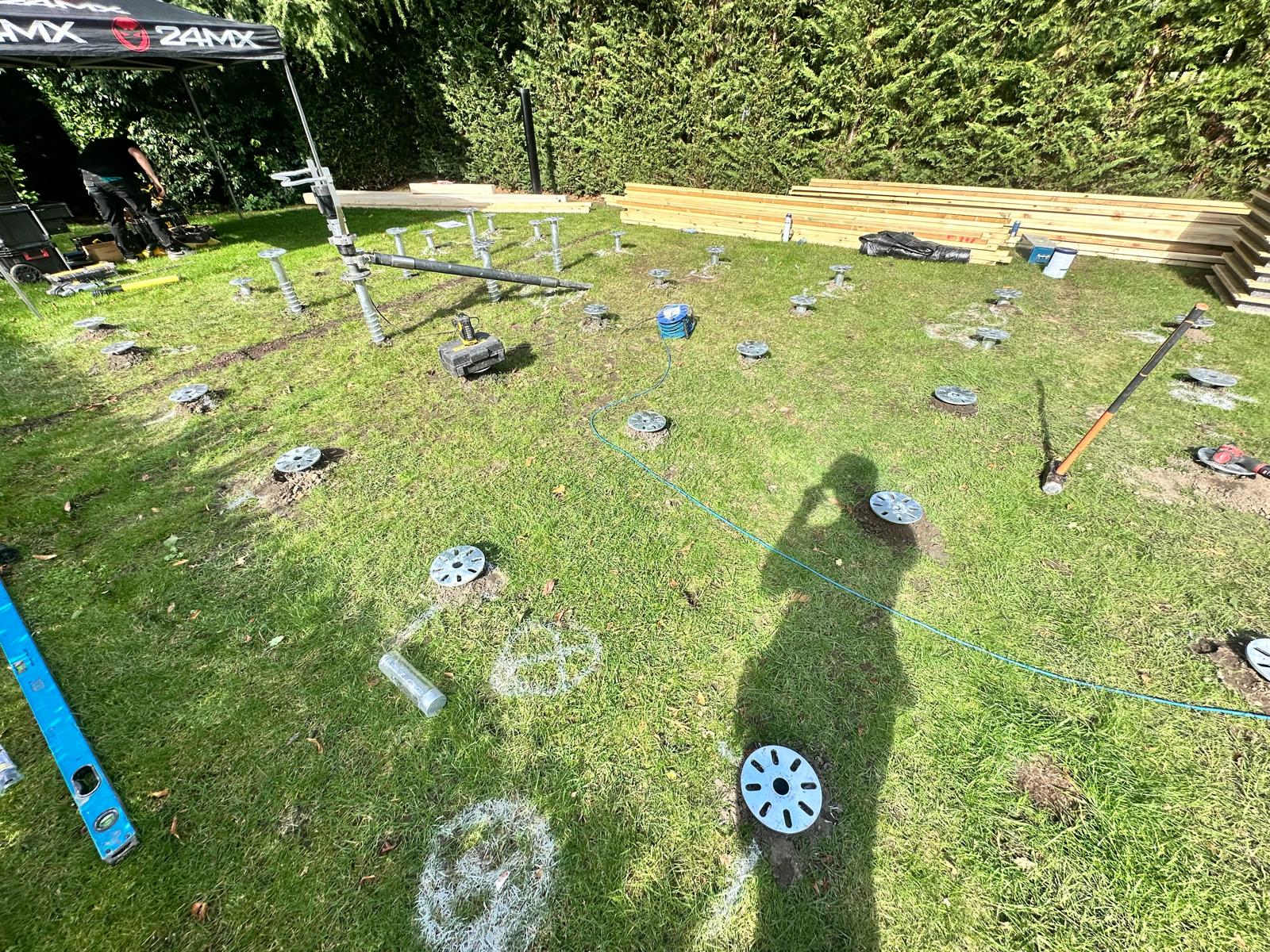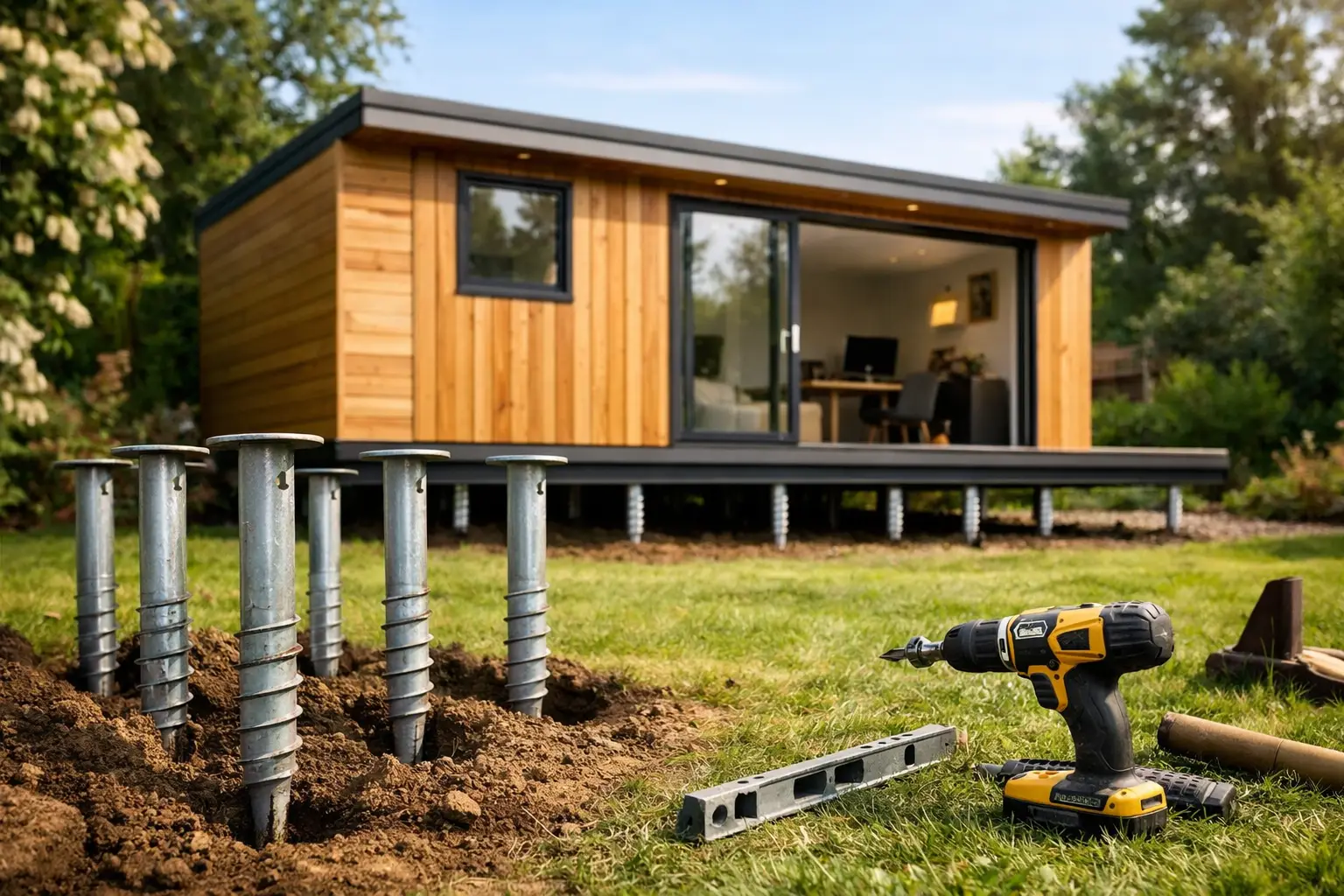
If your garden room programme slips because the base is late, everything above it slips too. That is why people keep asking, are ground screws suitable for garden rooms? In many cases, yes - and not just as a convenient alternative to concrete, but as the better foundation system for speed, accuracy and cleaner installation.
That said, suitability depends on the structure, the ground and the way the foundation is specified. A good result starts before a single screw goes into the ground.
Are ground screws suitable for garden rooms in real projects?
For most garden rooms, annexes and similar outdoor buildings, ground screws are a strong fit. They are especially well suited to timber-framed garden rooms, modular buildings and other structures where a level, square, build-ready base is needed quickly.
The main reason is simple. Garden rooms do not just need support. They need accurate support. If the foundation is out, the building team feels it immediately in the frame, floor and finishes. Ground screws allow that base to be set out precisely, installed without excavation and used straight away.
Compared with concrete, the practical advantages are obvious. There is no digging out, no spoil to remove, no wet trade on site and no waiting around for curing. The installation is faster, cleaner and easier to schedule. For builders and homeowners alike, that removes a lot of friction.
Why ground screws work well under garden rooms
Garden rooms are one of the clearest use cases for screw pile foundations because the installation method matches the project type. Most are built in gardens with limited access, close to existing landscaping, fences or neighbouring boundaries. Traditional excavation can turn a tidy site into a mess very quickly.
Ground screws avoid most of that disruption. The screws are mechanically driven into the ground to a specified depth and torque, then trimmed or bracketed to the required level. That means less disturbance to the site and a foundation that is ready for the next trade on the same day.
Speed matters, but so does consistency. A garden room base needs to be level across the whole footprint and properly aligned with the structure above. When screws are designed and installed correctly, they provide a repeatable, controlled way to achieve that.
This is also where specialist advice matters. The right screw size, length and bracket arrangement depend on loadings and ground conditions. It is not one-size-fits-all. Done properly, the system is quick because it is engineered, not improvised.
When ground screws are the better option than concrete
There are several situations where ground screws are not just suitable but preferable.
Uneven gardens are a common example. If the site falls away, concrete often means more excavation, more retained spoil and more effort getting the finished base to the right height. Ground screws can deal with level changes far more neatly.
Access is another big factor. Rear gardens in the South East are often awkward to reach, with narrow side passages and limited room for plant. Bringing in concrete or digging out by hand can be slow and disruptive. Ground screws reduce that problem because installation equipment is compact and spoil is not being generated.
They also make sense where the client wants to protect the garden. Patios, planting, lawns and finished landscaping are easier to work around when you are not pouring a slab. For many residential customers, that matters almost as much as the speed.
Then there is programme certainty. Concrete can introduce delays through weather, curing time and follow-on trades waiting for the base to be ready. Ground screws remove that pause. Once installed and checked, the foundation is ready to build from.
Where ground screws may not be the right choice
Not every site is straightforward, and a good contractor should say that plainly. Ground screws are suitable for many garden rooms, but there are cases where another foundation solution may be more appropriate.
Very poor ground conditions can affect feasibility. Made ground, heavy contamination, significant obstructions underground or highly variable strata may require further investigation. In some cases, the answer is still a screw pile system with the right design approach. In others, it may not be.
The building itself also matters. A standard insulated garden room is one thing. A much heavier structure, masonry building or unusually loaded annex may need a different foundation strategy or a more technical screw specification. The point is not that screws cannot handle serious loads - they can - but that the design must match the build.
There are also planning and utility considerations. Underground services, tree roots and site-specific constraints should always be checked before installation. Fast does not mean rushed.
What decides whether ground screws are suitable for your garden room?
The decision comes down to a handful of practical questions.
First is the building load. The size of the garden room, the wall and roof construction, insulation levels and internal use all affect the load going into the ground. A lightweight studio and a fully serviced annexe are not the same job.
Second is the ground itself. Soil type, bearing capacity and variability across the site all influence screw selection. This is why proper specification matters. The right diameter and length are chosen for the actual conditions, not guessed from the postcode.
Third is the layout of the subframe or chassis above. The foundation needs to support the structure at the correct points and to the right tolerances. That means the screw pattern must suit the building system, whether it is timber bearers, steelwork or a modular frame.
Finally, there is access and installation practicality. Some sites are simple. Others involve tight boundaries, mature gardens or restricted working space. A specialist installer plans for that before arriving on site.
Ground screws and garden rooms - what the installation looks like
A proper installation starts with the right information. Dimensions, loads, intended finished floor level and any site constraints need to be clear from the outset. If those details are vague, problems tend to show up later.
Once the foundation layout is set, the screw specification is matched to the project. On site, the footprint is set out accurately, the screws are driven in, levels are checked and the heads or brackets are adjusted to create a build-ready base.
The key point is readiness. There is no waiting for a slab to cure and no question about whether the concrete has gone off enough for the next stage. The building team can move straight onto the structure.
For trade customers, that means tighter scheduling. For homeowners, it means less disruption and less time with the garden turned into a work site.
Common concerns about using ground screws
One concern is movement. People assume a concrete slab must be more stable because it looks more substantial. In practice, stability comes from correct design, suitable ground conditions and accurate installation. A badly executed concrete base is still a bad base.
Another concern is lifespan. Quality steel screw piles used correctly are designed for structural foundation use, not as a temporary fixing. The exact specification matters, but this is a serious foundation system, not a shortcut.
Cost also comes up. Ground screws are not always cheaper on a line-by-line comparison with concrete. But total project value is wider than material cost alone. When you factor in speed, reduced labour, no excavation spoil, minimal reinstatement and same-day readiness, the case becomes much stronger.
The practical answer
So, are ground screws suitable for garden rooms? In most cases, yes - very much so. They are a practical fit for the way garden rooms are built, the sites they are built on and the level of precision the structure needs.
The real question is not whether screws are a modern alternative to concrete. It is whether the foundation is being specified properly for the building and the ground. That is where experience counts. A specialist contractor such as Ground Down will look at load, layout, soil conditions and access first, then recommend the right approach rather than forcing every project into the same detail.
If you want a foundation that is clean, accurate and ready to build from without dragging the job out, ground screws are often the right answer. The best next step is not guessing. It is getting the base right before the build starts.